Neck, Spine & Nerve Conditions

Neck and Back Pain

Neck and Back Pain

Definition

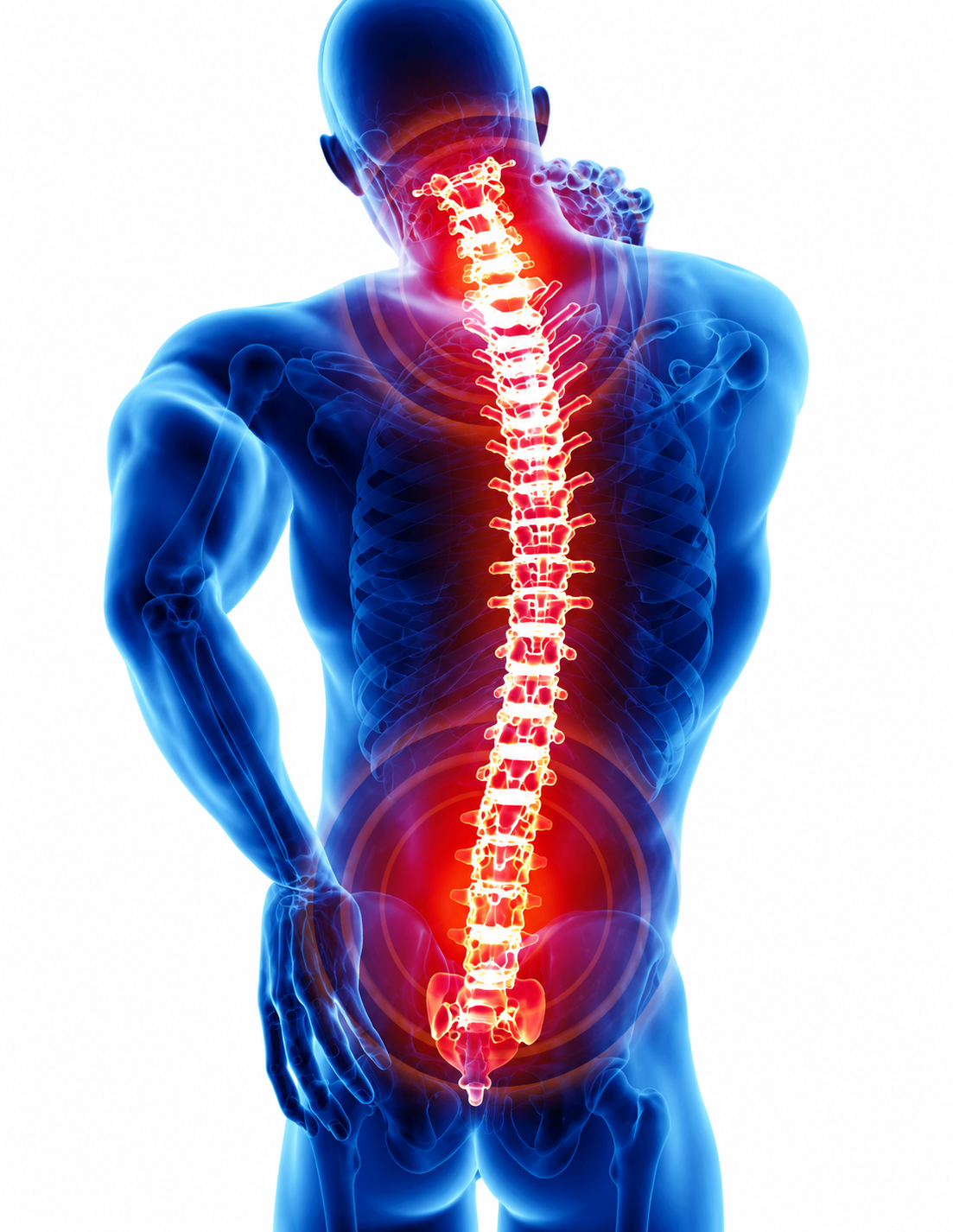
Neck and back pain commonly refers to mechanical pain without a clearly identified serious pathology. It may involve muscles, joints, ligaments, discs, and pain sensitivity, and can recur and affect sitting, sleep, work, and daily activities.

Cause

Prolonged fixed posture, sudden load increases, poor sleep, stress, previous pain, and too little or too much activity can reduce the tolerance of spinal tissues and the nervous system.

Risk Factors

  • Prolonged sitting, standing, or repetitive bending and twisting
  • Sudden increases in work, training, or household load
  • Physical deconditioning, inactivity, or persistent poor sleep
  • High stress, anxiety, or recurrent pain history

Common Symptoms

  • Local pain and stiffness in the neck, upper back, or low back
  • Worse pain after sitting, bending, turning, or certain postures
  • Discomfort when starting movement that may ease with tolerable activity
  • Muscle tension and reduced movement range or daily tolerance

Management

Management prioritises tolerable activity and avoids prolonged bed rest. A physiotherapist assesses movement, work posture, sleep, load, and psychosocial factors, then prescribes graded mobility, strengthening, trunk endurance, and aerobic exercise; manual therapy may support exercise and self-management. Seek early medical review for severe pain after trauma, fever, unexplained weight loss, or neurological symptoms.

Prevention

Break prolonged sitting or standing into shorter periods and change position regularly. Maintain regular walking or aerobic exercise plus neck, back, and hip strengthening each week. Progress work or training gradually and address sleep and stress management.
Spinal Radiculopathy / Nerve Root Pain

Spinal Radiculopathy / Nerve Root Pain

Definition

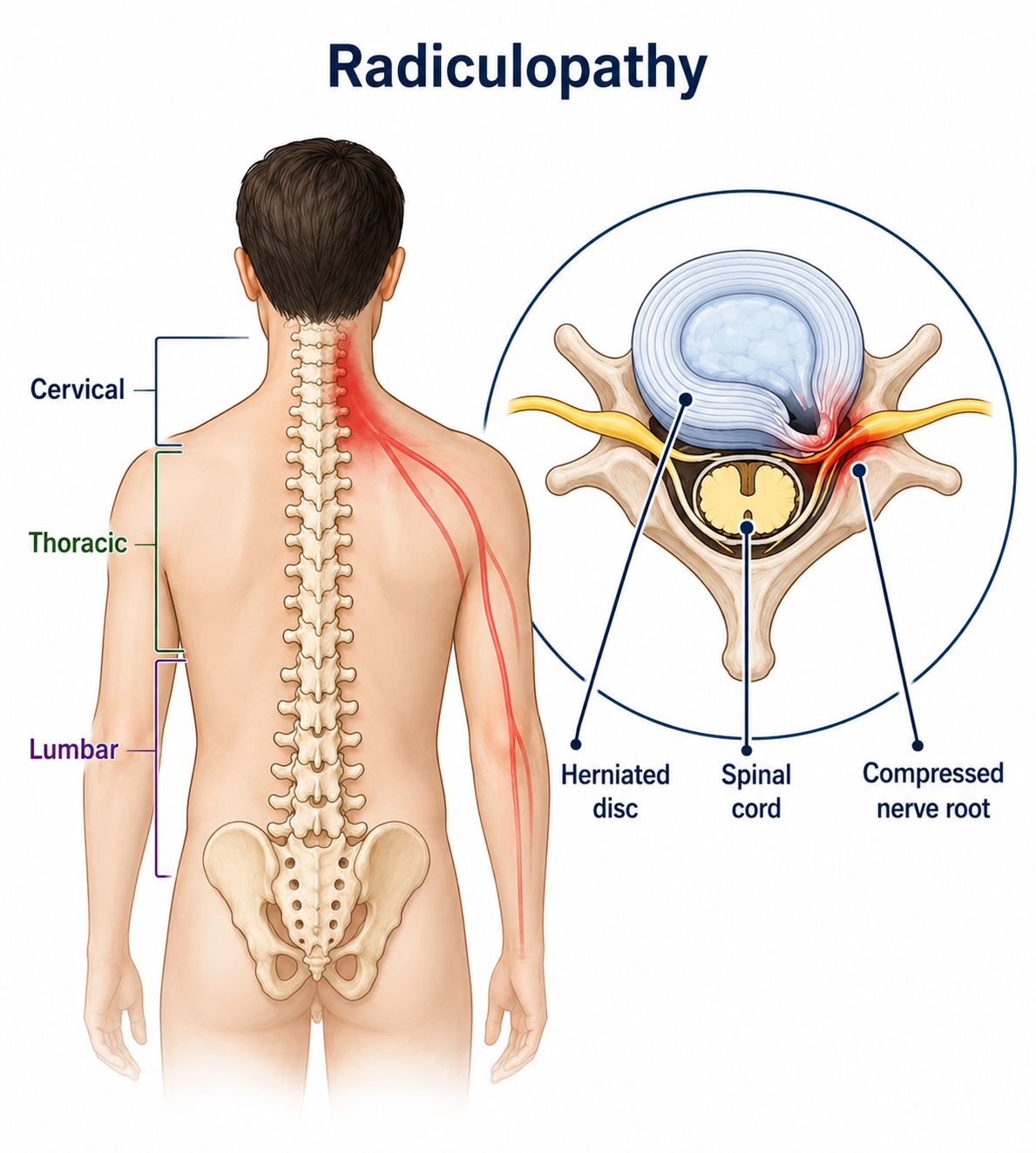
Spinal radiculopathy occurs when a cervical or lumbar nerve root is irritated, inflamed, or compressed. Cervical radiculopathy may cause pain, numbness, or weakness from the neck into the arm; lumbar radiculopathy may extend from the low back into the buttock and leg and is commonly called sciatica.

Cause

Common mechanisms include disc herniation, degenerative narrowing, joint or bony changes, and less commonly trauma or other pathology. Symptom severity does not always match scan findings and should be interpreted with neurological examination.

Risk Factors

  • Disc or joint degeneration with age
  • Repeated heavy lifting, bending and twisting, or prolonged fixed posture
  • Previous spinal trauma or radiculopathy
  • Smoking, diabetes, or reduced overall fitness

Common Symptoms

  • Pain radiating from the neck into the shoulder, arm, or fingers, or from the low back into the buttock, leg, or foot
  • Numbness, tingling, or burning in a dermatomal pattern
  • Weakness in specific muscles, reduced grip, or ankle weakness
  • Symptoms that may worsen with coughing, sneezing, neck flexion, or bending

Management

Physiotherapy assesses strength, sensation, reflexes, and neural mechanosensitivity, then uses education, activity modification, directional exercises, graded spinal and limb training, and neural gliding. Cervical symptoms may be managed with cervicothoracic mobility and stability work; lumbar symptoms focus on movements that reduce leg pain and gradual return to walking and loading. Progressive weakness, foot drop, saddle numbness, or bladder/bowel changes require urgent medical attention.

Prevention

Keep loads close to the body and avoid repeated bending and twisting when fatigued; maintain neck, trunk, hip, and leg strength, and seek early assessment for recurrent radiating pain or numbness rather than pushing through symptoms.

Spinal Disc Herniation

Spinal Disc Herniation

Definition

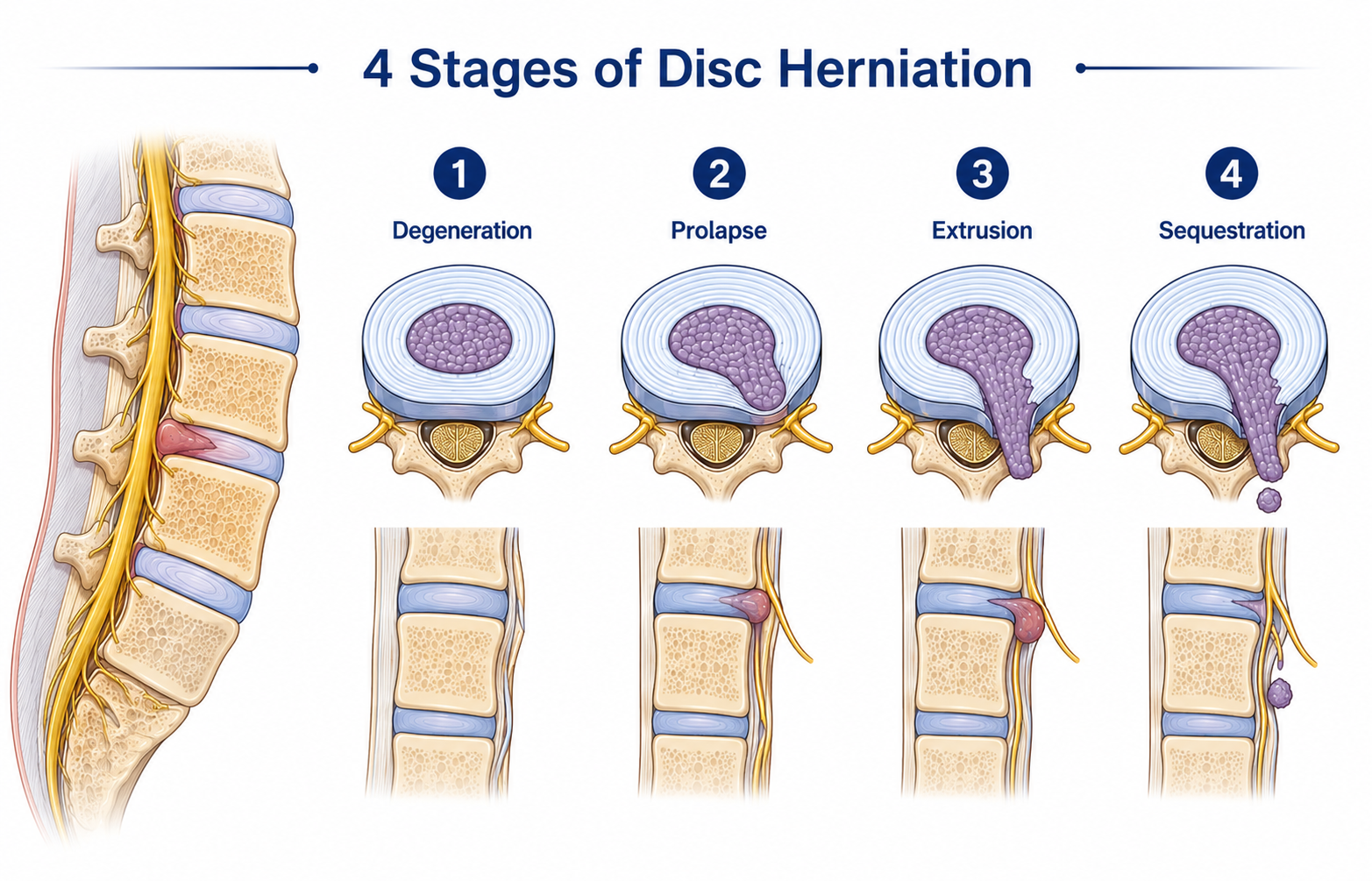
Intervertebral discs sit between spinal bones to distribute load and permit movement. When the outer annulus is injured and inner material displaces outward, nearby nerve roots may be irritated; this can occur in the cervical or lumbar spine. Some herniations are symptom-free, and symptoms depend on the degree of neural involvement.

Cause

Disc herniation can occur as the disc changes over time and may sometimes be associated with lifting, bending, twisting, or other loading events. In many cases there is no single identifiable cause, and disc changes can also be present without symptoms.

Risk Factors

  • Repeated bending and lifting or flexion combined with rotation
  • Sudden increases in work or training load
  • Smoking, low fitness, or prolonged sitting
  • Previous disc-related pain or familial susceptibility

Common Symptoms

  • Neck or low back pain with possible arm or leg radiation
  • Worse pain with sitting, bending, coughing, or sneezing
  • Numbness, tingling, weakness, or restricted movement
  • Some people have local pain only, without neurological symptoms

Management

Most cases can initially be managed conservatively with tolerable activity, avoidance of prolonged bed rest, symptom-guided directional movement, and graded trunk, hip, and limb training. A physiotherapist monitors neurological status and rebuilds lifting, sitting, and exercise tolerance. Persistent severe limb pain, worsening neurological deficit, or cauda-equina warning signs require medical assessment.

Prevention

Maintain regular physical activity and gradually build tolerance for lifting, bending, exercise, and other demanding tasks. Use comfortable movement strategies, allow adequate recovery when activity demands increase, and avoid smoking.

Spinal Spondylosis

Spinal Spondylosis

Definition

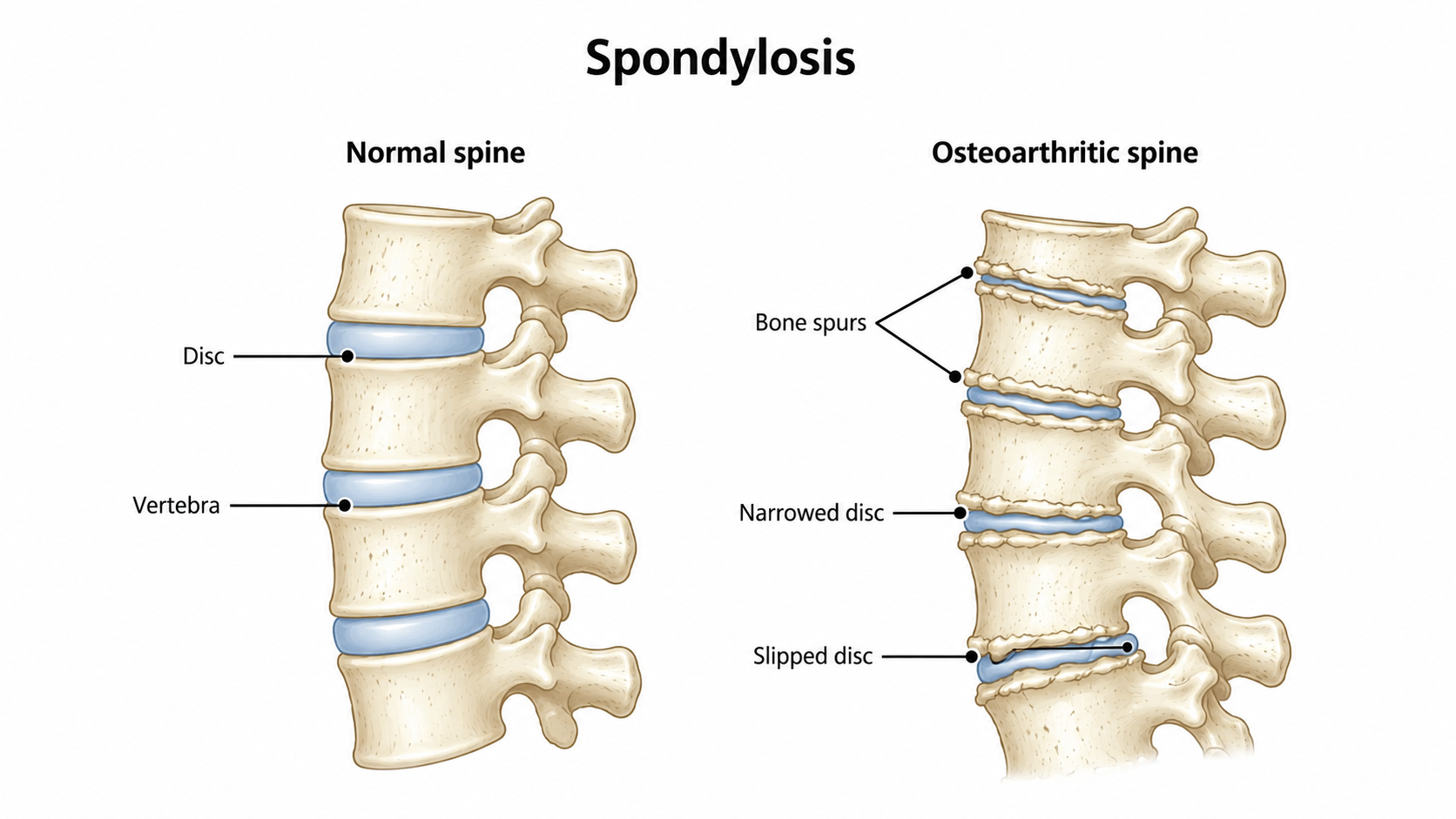
Spinal spondylosis describes age-related structural changes in discs, joints, ligaments, and bone, occurring in the cervical or lumbar spine. Degenerative findings on imaging are common and do not necessarily explain pain; treatment should be guided by symptoms, function, and neurological examination.

Cause

Long-term loading and natural ageing can reduce disc hydration and thicken joints and ligaments, causing local pain, stiffness, or narrowing of neural spaces in some people.

Risk Factors

  • Increasing age and family history
  • Long-term smoking, low fitness, or obesity
  • Previous spinal trauma or repetitive heavy labour
  • Prolonged inactivity or poor load management

Common Symptoms

  • Neck or low back stiffness and reduced movement range
  • Local pain after activity or prolonged posture
  • A catching or tight feeling with turning, bending, or getting up
  • Radiating pain, numbness, or weakness if neural structures are affected

Management

Management aims to improve function rather than simply "correct" imaging degeneration. Physiotherapy focuses on joint movement, spinal and hip strength, walking or aerobic capacity, daily-task training, and adjustment of work posture and load. Progressive neurological weakness, gait change, or hand clumsiness, especially with cervical symptoms, needs medical assessment.

Prevention

Continue aerobic activity such as walking, swimming, or cycling with neck, back, hip, and leg strengthening and mobility work. Avoid prolonged inactivity, break up repetitive tasks, and change posture regularly.

Spinal Stenosis

Spinal Stenosis

Definition

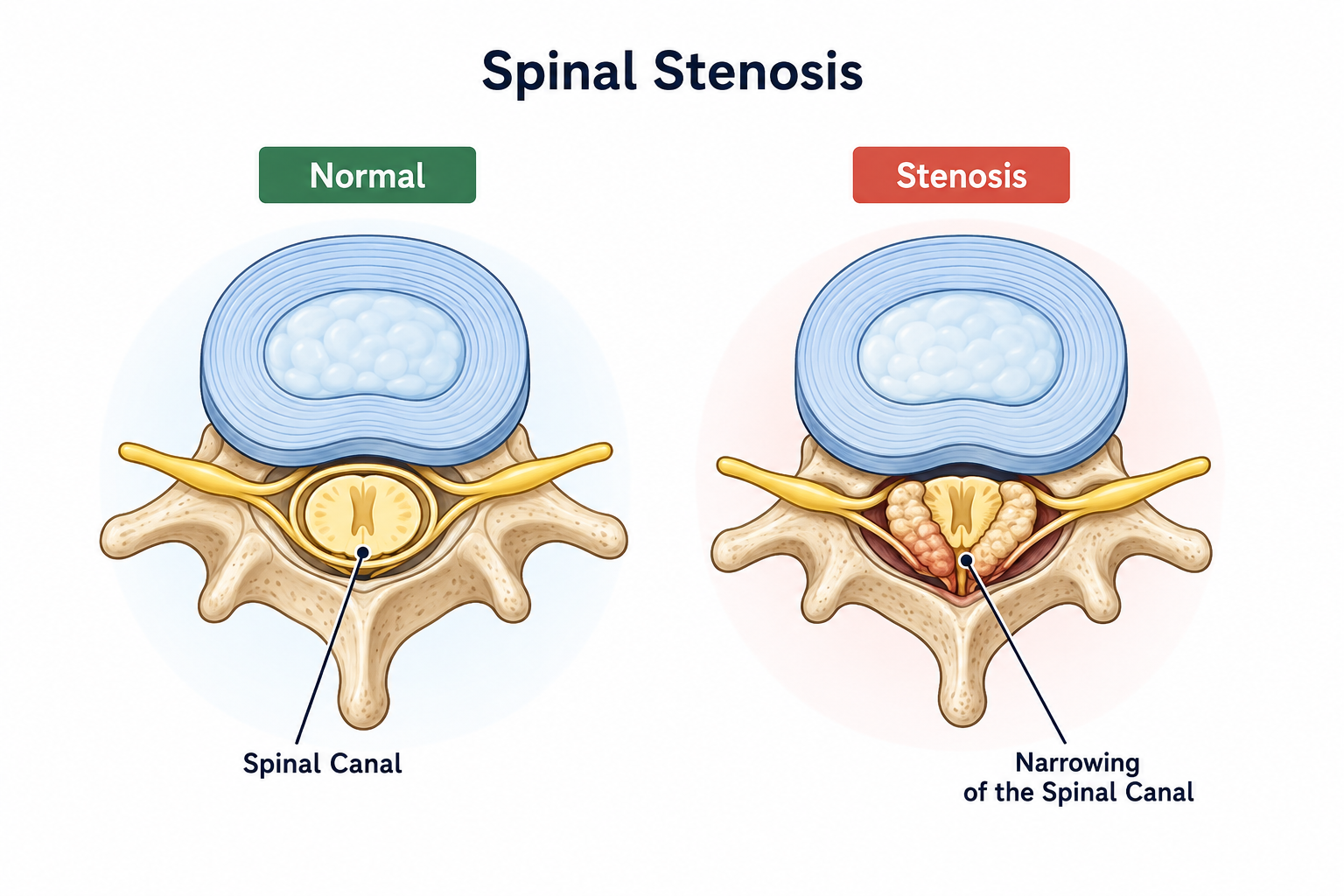
Spinal stenosis is narrowing of the central spinal canal or neural foramina, which can compress or irritate neural tissue. It is most common in the lumbar spine and may cause neurogenic claudication; cervical stenosis requires particular attention because of possible spinal-cord compression.

Cause

It is commonly associated with age-related disc degeneration, enlarged joints, thickened ligaments, or spondylolisthesis, reducing space available for neural structures.

Risk Factors

  • Increasing age and multilevel degeneration
  • Spondylolisthesis or previous spinal surgery
  • Obesity, reduced activity, or low fitness
  • Congenitally narrow spinal canal

Common Symptoms

  • Buttock and leg pain, numbness, or heaviness after standing or walking
  • Symptoms relieved by sitting, bending forward, or leaning on a shopping trolley
  • Progressively reduced walking distance while cycling may be better tolerated
  • Hand clumsiness, unsteady gait, or limb weakness when the cervical spine is affected

Management

Physiotherapy for lumbar stenosis uses tolerable flexion-biased movement, interval walking, cycling or aquatic exercise, hip, leg, and trunk strengthening, and balance work to progressively extend walking capacity. Cervical stenosis with myelopathic signs such as deteriorating gait, reduced hand dexterity, or progressive weakness requires prompt specialist assessment.

Prevention

Maintain regular walking, cycling, or aquatic exercise and leg strength rather than stopping activity completely from fear of pain. Break long walks into intervals and use an appropriate walking aid or support strategy when needed.

Spondylolisthesis

Spondylolisthesis

Definition

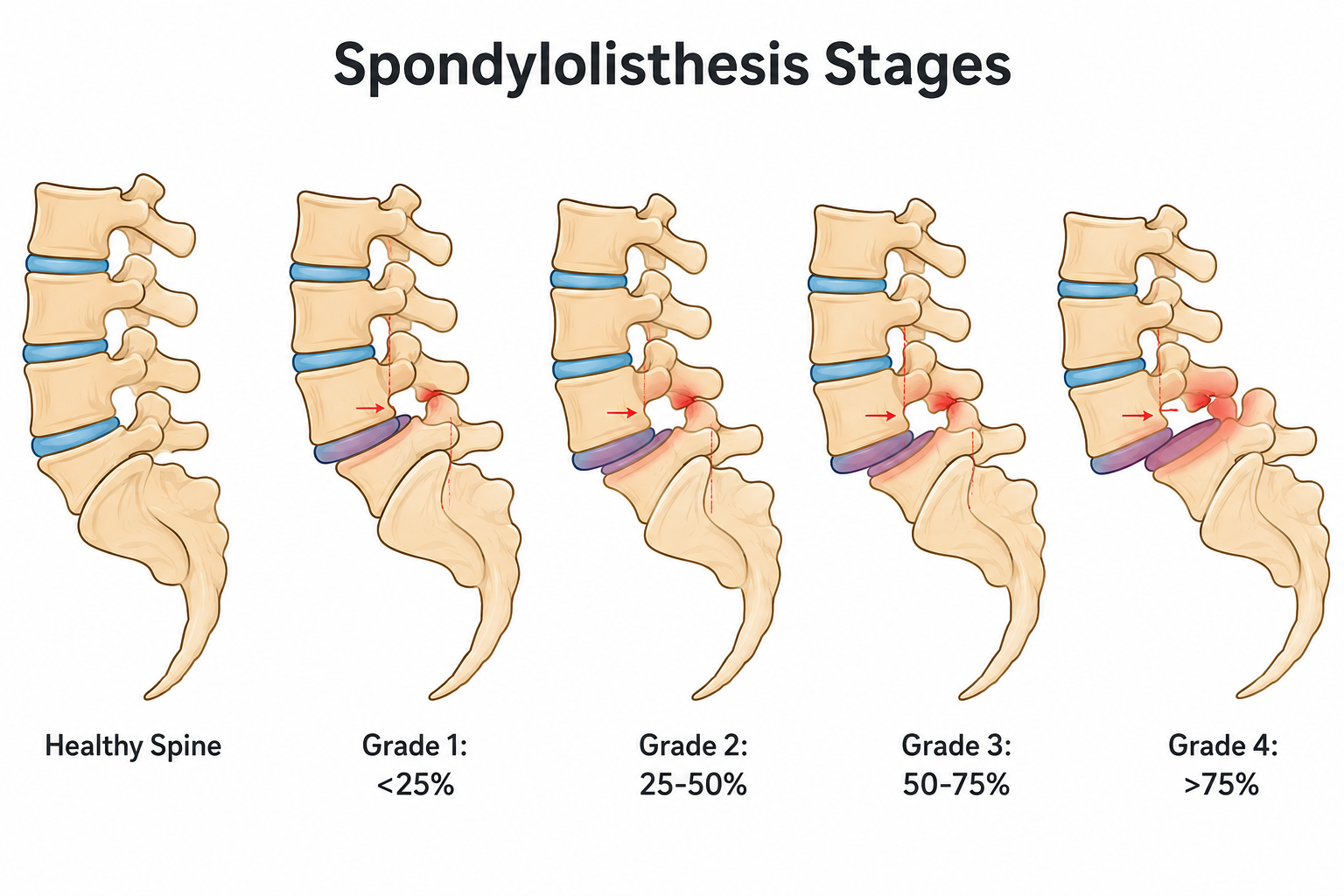
Spondylolisthesis is forward or backward displacement of one spinal vertebra relative to the level below, most commonly in the lower lumbar spine. It may relate to degeneration, stress injury, congenital structure, or trauma, and some people have no symptoms.

Cause

Spondylolisthesis can develop through age-related changes, stress injury to part of the vertebra, congenital structural differences, or trauma. The underlying mechanism varies according to the type of spondylolisthesis.

Risk Factors

  • Age-related changes in the lumbar spine
  • Repeated high-load spinal activity in some individuals
  • Structural or familial factors
  • Previous spinal stress injury or trauma

Common Symptoms

  • Low back pain, often worse with prolonged standing, walking, or lumbar extension
  • Buttock or leg pain, numbness, or heaviness when neural narrowing coexists
  • Lumbar stiffness, reduced confidence with movement, or reduced endurance
  • Obvious postural change or neurological symptoms in more severe cases

Management

Conservative rehabilitation is usually the first approach when appropriate. Physiotherapy focuses on adjusting activities that aggravate symptoms, improving trunk and hip strength and control, and gradually restoring tolerance for daily and higher-demand activities. High-grade slippage, worsening symptoms, or neurological deficits require specialist medical assessment.

Prevention

Build spinal and lower-limb capacity gradually for activities that place greater demands on the back. Avoid sudden large increases in demanding activity and allow adequate recovery when activity levels change.

Sacroiliac Joint Dysfunction

Sacroiliac Joint Dysfunction

Definition

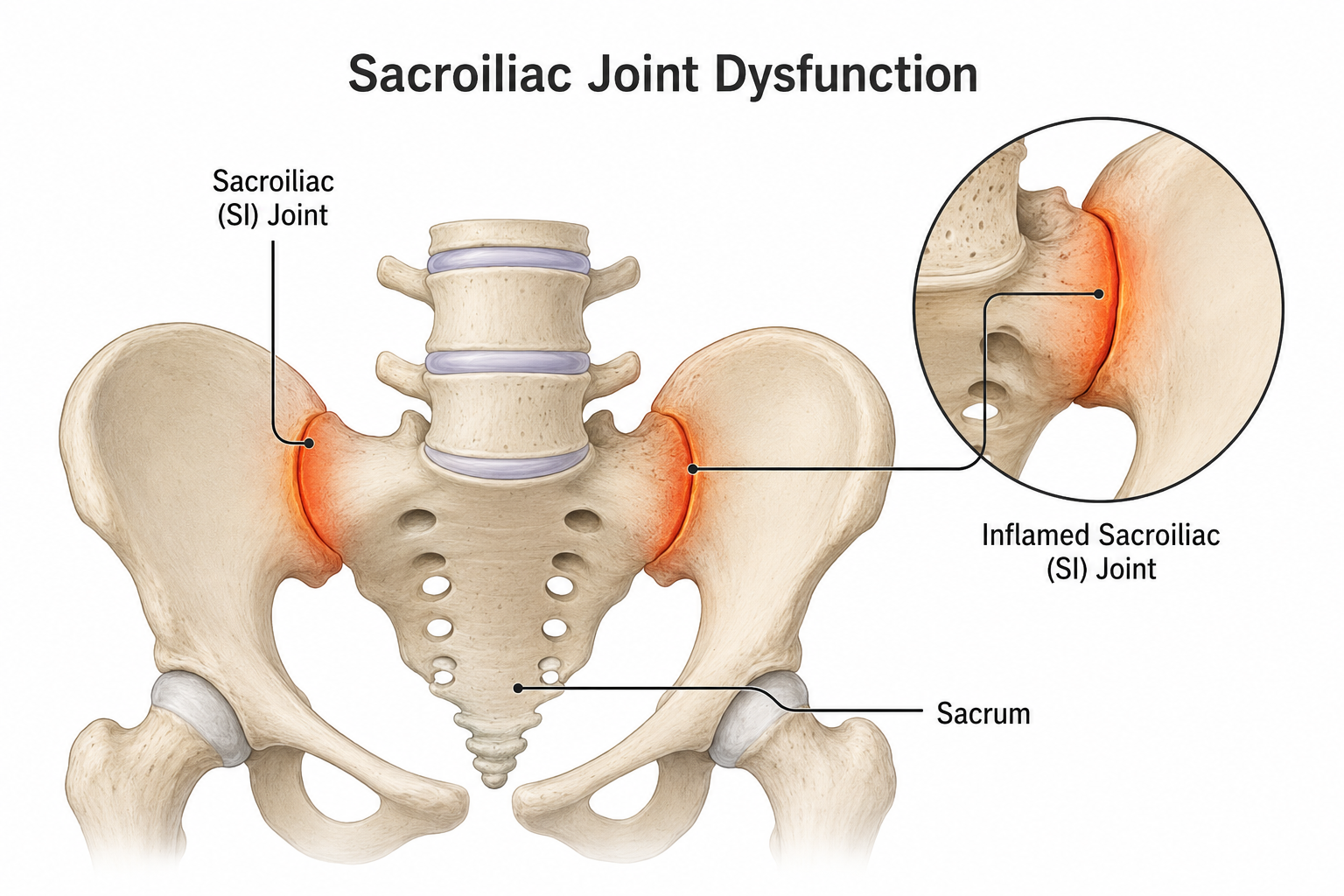
The sacroiliac joint sits between the base of the spine and pelvis and transfers load between the trunk and lower limbs. Sacroiliac joint dysfunction refers to pain or load-control problems in this region, usually presenting as one-sided buttock or posterior pelvic pain.

Cause

Sacroiliac joint pain may develop following trauma, pregnancy-related changes, or changes in loading around the pelvis. In many cases, there is no single identifiable cause, and symptoms should be assessed alongside possible lumbar and hip sources.

Risk Factors

  • Pregnancy-related changes
  • Previous pelvic or lower-limb trauma
  • Significant changes in physical activity or loading
  • Previous episodes of pelvic or lower-back pain

Common Symptoms

  • One-sided buttock or posterior pelvic pain, often near the dimples
  • Pain when turning in bed, rising from sitting, standing on one leg, or climbing stairs
  • Discomfort after walking, running, or prolonged standing
  • Pain may refer to the back of the thigh but usually not to the foot

Management

Assessment first considers whether symptoms may originate from the lumbar spine, hip, or other nearby structures. Physiotherapy can then focus on maintaining comfortable movement, improving hip and trunk strength, and gradually restoring tolerance for walking, lifting, transfers, and other relevant daily activities.

Prevention

Maintain regular activity and gradually build tolerance for lifting, walking, and other activities that place greater demand on the pelvis. After injury or during periods of increased symptoms, adjust aggravating activities and progressively restore hip and trunk strength and function.

Piriformis Syndrome

Piriformis Syndrome

Definition

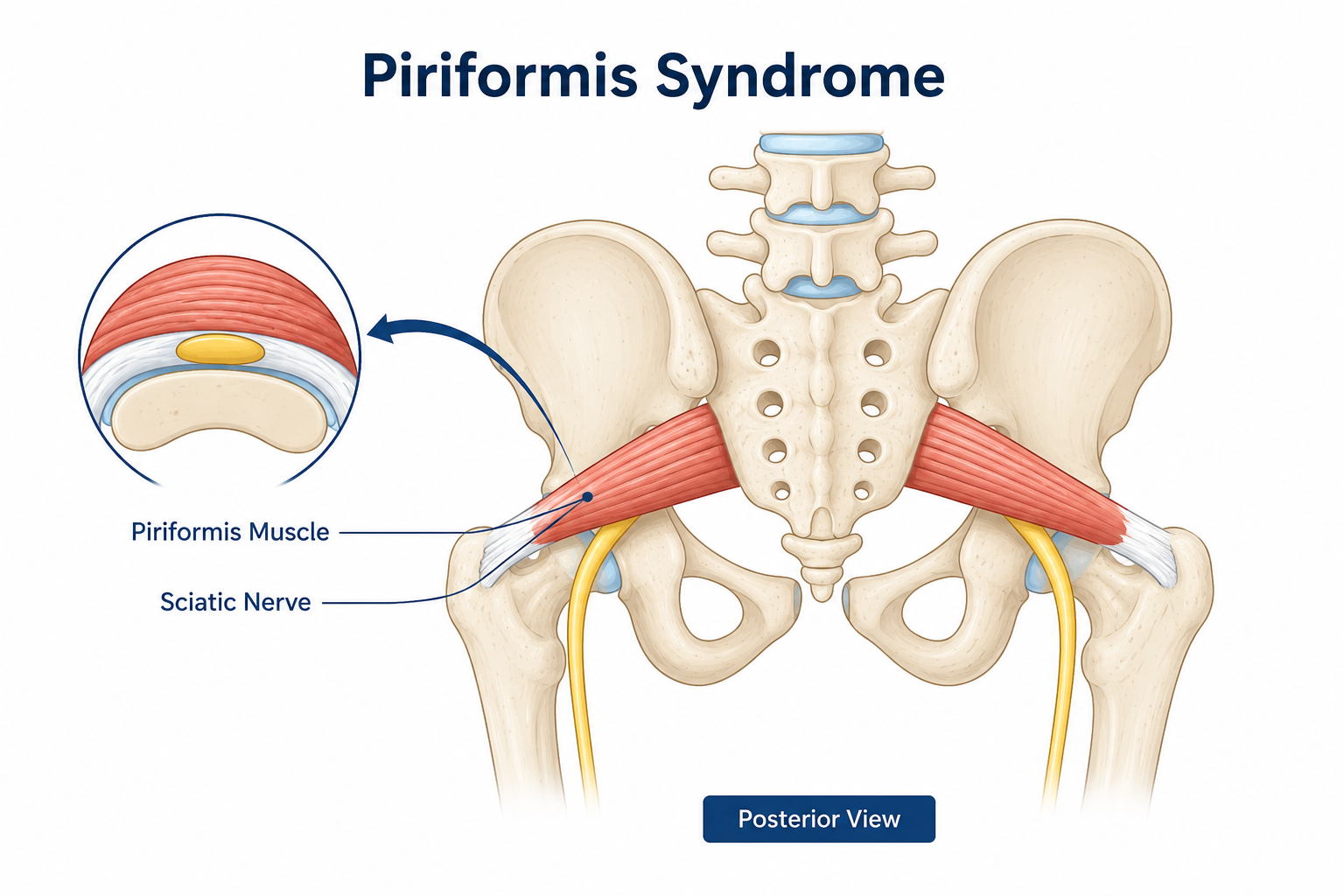
Piriformis syndrome describes possible irritation of the sciatic nerve by the deep piriformis muscle or nearby structures, causing buttock pain and sciatica-like symptoms. It must be differentiated from lumbar radiculopathy, hip disorders, and other deep-gluteal conditions.

Cause

Symptoms may be associated with irritation or compression of the sciatic nerve within the deep gluteal region. Trauma, prolonged pressure around the buttock, or changes in hip and lower-limb activity may contribute, although other causes of sciatica-like symptoms should first be considered.

Risk Factors

  • Prolonged pressure around the buttock
  • Previous trauma to the buttock or hip region
  • Significant changes in lower-limb activity
  • Repeated activities that reproduce deep buttock symptoms

Common Symptoms

  • Deep buttock pain or tenderness, often worse after prolonged sitting
  • Pain may radiate down the back of the thigh and may include tingling
  • Discomfort with crossing the legs, squatting, hill walking, or running
  • Lumbar movement and neurological testing help distinguish a lumbar source

Management

Management first considers whether symptoms may originate from the lumbar spine or another source. Physiotherapy may include activity modification, hip mobility and strengthening, movement rehabilitation, and gradual restoration of sitting, walking, and other relevant activities according to the individual's symptoms.

Prevention

Avoid prolonged pressure on the painful buttock and change position regularly during extended sitting. When increasing lower-limb activity, allow time for the hip and surrounding tissues to adapt and maintain comfortable hip strength and movement.

Thoracic Outlet Syndrome

Thoracic Outlet Syndrome

Definition

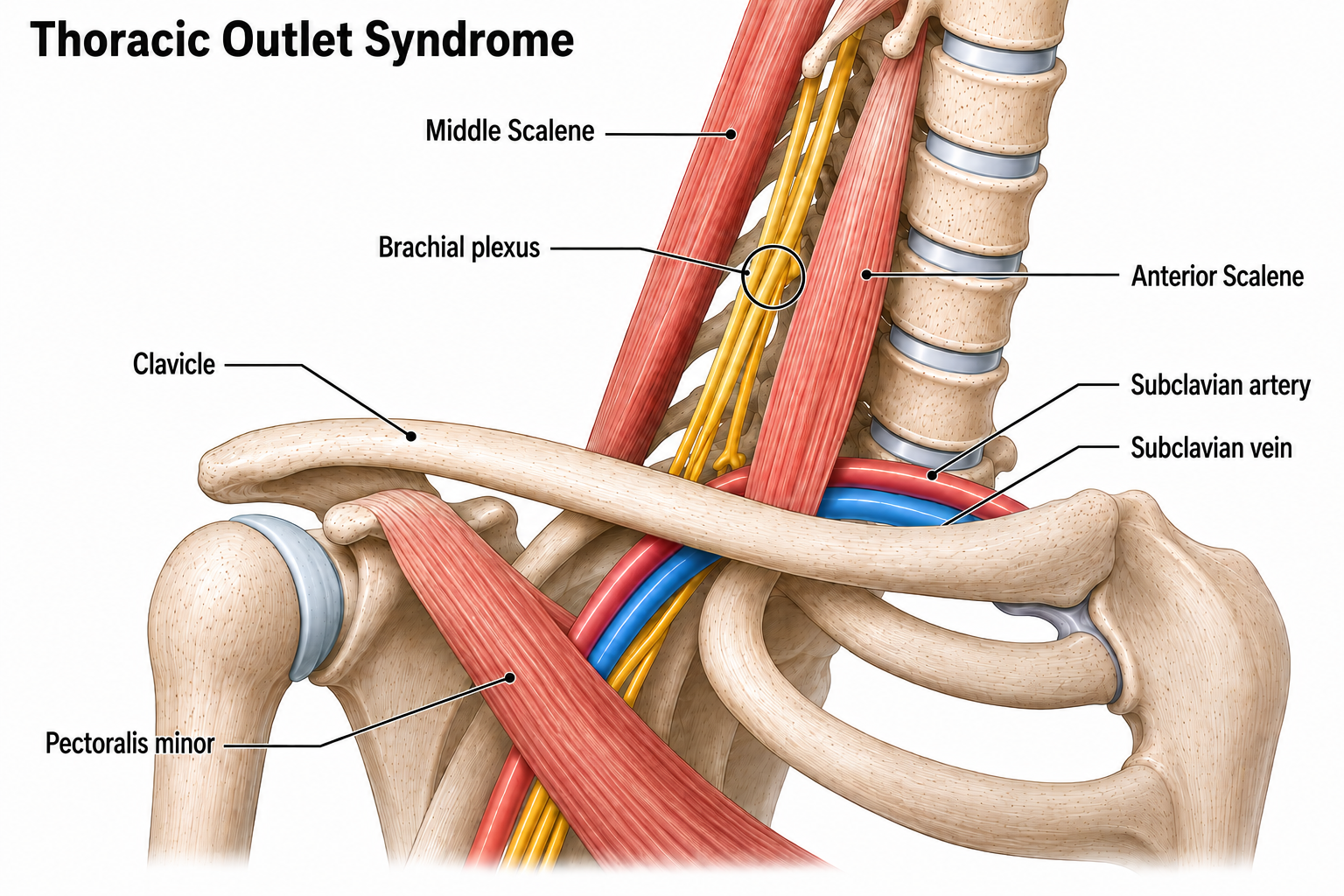
Thoracic outlet syndrome is an umbrella term for symptoms related to compression of nerves or blood vessels in the space around the clavicle, first rib, and scalene muscles. The neurogenic type is most common and may cause neck and shoulder pain, arm fatigue, and numbness; vascular types are less common but require early recognition.

Cause

Thoracic Outlet Syndrome can be associated with compression of nerves or blood vessels around the thoracic outlet. Contributing factors may include anatomical differences, previous trauma, repetitive or sustained arm positions, and activities that place greater demand on this region.

Risk Factors

  • Repeated or sustained elevated arm positions
  • Previous neck, shoulder, or clavicle trauma
  • Individual anatomical differences
  • Repeated activities that place greater demand on the shoulder region

Common Symptoms

  • Pain in the neck, above the clavicle, or shoulder with arm fatigue or heaviness
  • Numbness, tingling, or weakness with arm elevation, carrying, or prolonged work
  • Altered finger sensation or reduced grip
  • Vascular warning signs include arm swelling, colour change, coldness, or sudden marked pain

Management

Management first considers cervical radiculopathy, peripheral nerve conditions, and possible vascular causes. For neurogenic presentations, physiotherapy may include shoulder and upper-back strengthening, mobility exercises, activity modification, and gradual restoration of comfortable arm use. Sudden arm swelling, marked colour change, coldness, or severe unexplained arm pain requires urgent medical assessment.

Prevention

Vary prolonged arm positions where possible and gradually build tolerance for activities that require sustained or repeated use of the arms. Maintain comfortable shoulder and upper-back strength and movement, particularly when activity demands increase.

Ankylosing Spondylitis / Axial Spondyloarthritis

Ankylosing Spondylitis / Axial Spondyloarthritis

Definition

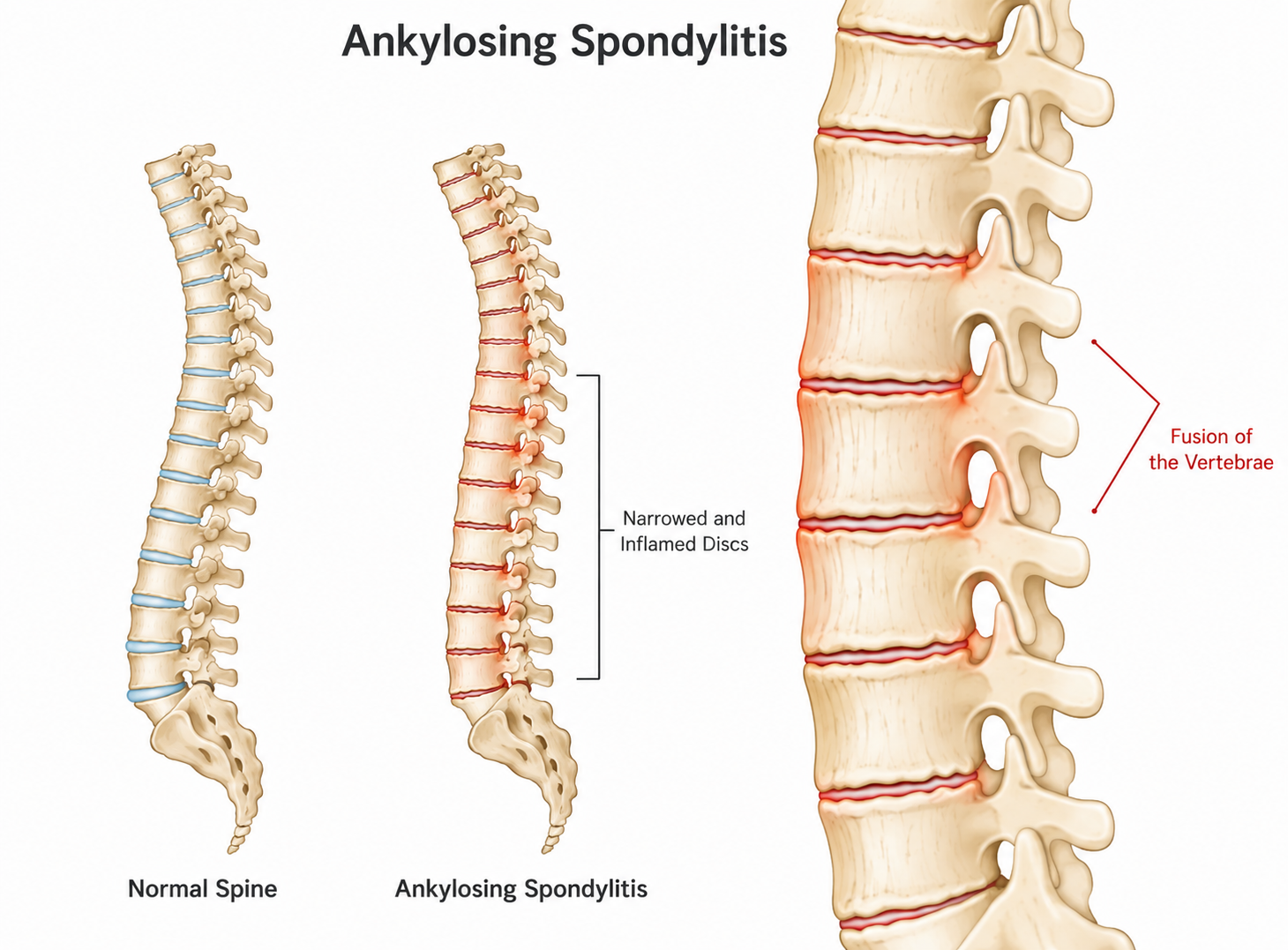
Axial Spondyloarthritis is a chronic inflammatory condition that mainly affects the spine and sacroiliac joints. It can cause persistent back pain and stiffness, and some people may develop structural changes that reduce spinal mobility over time. Ankylosing Spondylitis refers to the form in which characteristic structural changes are visible on X-ray.

Cause

The exact cause of axial spondyloarthritis is not fully understood. Genetic and immune factors are involved, with HLA-B27 strongly associated with the condition. Persistent inflammation can affect the spine and sacroiliac joints and, in some people, lead to structural changes over time.

Risk Factors

  • HLA-B27 positivity
  • Family history of axial spondyloarthritis
  • Symptoms commonly beginning in adolescence or early adulthood
  • Smoking is associated with poorer outcomes in people with the condition

Common Symptoms

  • Inflammatory low back and buttock pain worsening with rest
  • Morning stiffness lasting over 30 minutes
  • Waking at night due to pain
  • Reduced spinal mobility and chest expansion

Management

Management combines appropriate medical treatment with regular physical activity and physiotherapy. Physiotherapy focuses on maintaining spinal and chest mobility, strength, posture, breathing capacity, and general fitness. Exercise can be adjusted during symptom flares and progressed according to the person's condition and functional needs.

Prevention

The condition itself cannot currently be reliably prevented. For people with axial spondyloarthritis, regular exercise, avoiding smoking, and maintaining spinal mobility and general fitness can support long-term function and health.

Book
Ask